
TEAM PERFORMANCE

Great teams aren’t built on guesswork. Assess where your team is, work on what matters, and measure what changes.

The challenge

0 %

12% of employees in Europe are engaged with their work, their team and their organisation.

Source: Gallup

Most learning and development invests in individual knowledge and skills. But performance depends on how people work together.

Many tools help people understand their personalities. They give insights, but don’t tell the team what to do next, and they don’t measure the key elements of teamwork.

Most organisations don’t measure the outcome of their development initiatives, so they can’t tell whether any of it is working.

Teams need a clear picture of how they work today, a way to decide what to improve, and a way to do it and measure what changes.

That’s what the Essentials of Team Performance© framework is built for.

The Essentials of Team Performance©

What makes a team truly perform?

After 20 years building and leading teams, and 8 years helping them get stronger, I found that existing tools never captured the full picture. So, based on my experience and my own research, I created a framework and assessment tool that shows what makes teams work, what holds them back and how to improve.

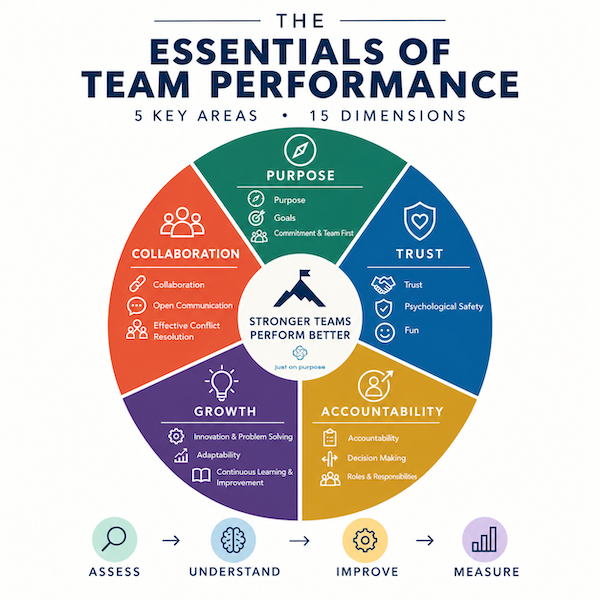
It covers 5 key areas and 15 dimensions, helping teams see their strengths, decide what to improve, and track progress over time.

It’s a wheel, not a checklist: the areas depend on each other, so strengthening one makes the others easier to improve.

5 Areas. 15 Dimensions

Purpose

Purpose · Goals · Commitment & Team First
Why the team exists and where it’s heading. Strong teams share a clear purpose, translate it into goals everyone understands, and commit to them, putting the team ahead of individual agendas.

Trust

Trust · Psychological Safety · Fun
The foundation everything else is built on. Team members trust each other, feel psychologically safe to speak up, ask questions and admit mistakes, and enjoy working together. Fun is part of it, because teams that enjoy each other’s company connect more and bounce back faster.

Accountability

Accountability · Decision Making · Roles & Responsibilities
Clear expectations, followed through. Everyone knows their role and responsibilities, decisions are made well and on time, and people can count on each other to deliver.

Growth

Innovation & Problem Solving · Adaptability · Continuous Learning & Improvement
How the team keeps getting better. Strong teams adapt as circumstances change, solve problems creatively, and keep learning and improving, rather than waiting for something to go wrong.

Collaboration

Collaboration · Open Communication · Effective Conflict Resolution
How people work through things together. Team members share their work, communicate openly, and handle disagreement constructively instead of avoiding it.

How it works?

From insight to measurable improvement

Four steps, built on the Essentials of Team Performance© framework.

Step 1

Assess

Share the Team Pulse

One link goes to every team member. Each person rates statements linked to every dimension of the wheel, from their own perspective. Answers are anonymous.

Step 2

Understand

Get the full picture

A full report at team and individual level: scores and what they mean in every area and dimension, strongest and weakest elements, who is more positive or negative, and what to focus on to improve.

Step 3

Improve

Follow a tailored journey

Sessions of one or two days, mostly outdoors, designed around your needs and budget and focused on the weakest dimensions. Each session builds on the last, so new behaviours become habits.

Step 4

Measure

See what changed

At the end of the journey we run the Team Pulse again and compare. You see where the team stands now and whether it improved thanks to the work we did together.

Who is it for?

New teams

Starting well saves months of trial and error. Build a shared purpose, clear roles and trust from the beginning, instead of discovering the gaps later.

Teams with new members

When someone joins, the team changes. Help everyone find their place and set the ways of working that make the new team stronger.

Teams facing challenges

Performance has flattened, or tension, change or pressure is getting in the way. Find out what’s really holding the team back and what to do about it.

Teams with a new leader

A new leader means new expectations and a new dynamic. Get a clear picture of where the team stands and build a strong foundation together.

What people say

Ready to build a
high-performing team?